
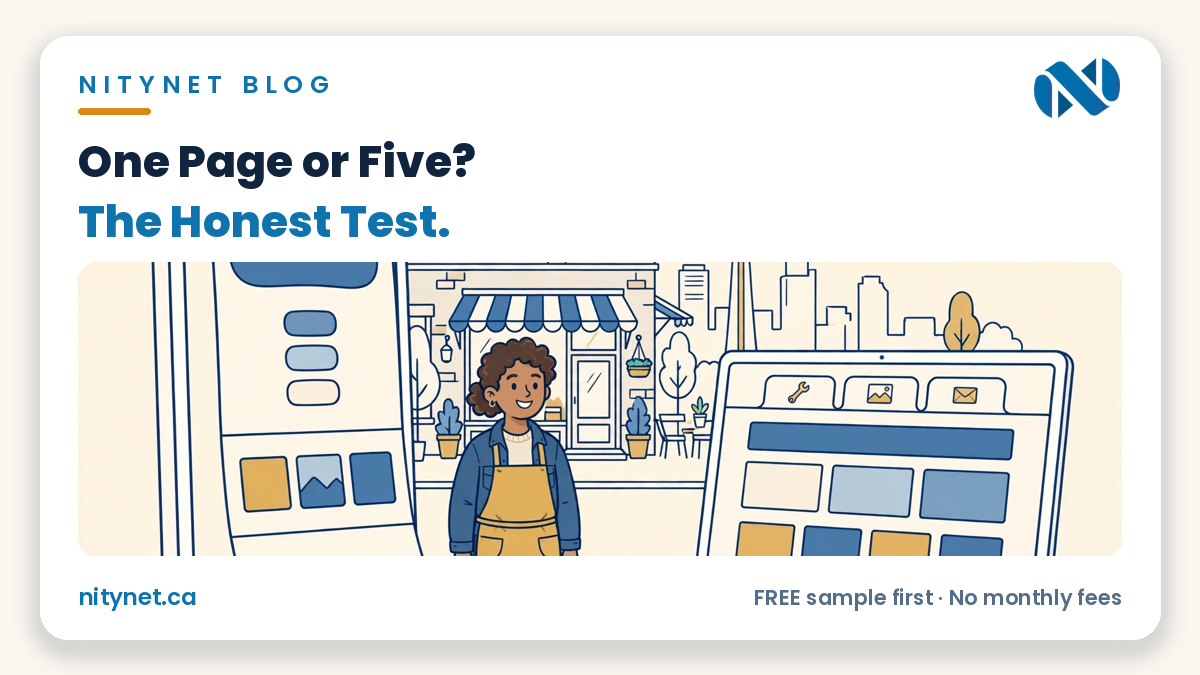
One page website vs full website: a one-page site is one page with everything on it; a full website gives each topic its own page. One page is enough when customers ask one or two questions and act by phone. A full site earns its cost when you sell services, take bookings or orders, or need each service findable separately.
The two shapes, in plain words
The one-page site is one scroll. Who you are, what you do, your prices, your hours and a tap-to-call button all sit on a single page, in order, with nothing hidden behind a menu. A customer lands, scrolls, and has everything in under a minute — there is nowhere else to go.
The full website gives each topic its own page. The standard set — Home, Services, About, Reviews and Contact, plus one page written for your trade — is listed in our guide to what pages a small business website needs. Each service, the gallery, the booking path and the contact page live on their own pages, so a customer who wants only one goes straight to it.
Neither shape is a trick. They are two different answers to the same question: how much does a stranger need to read before they act? You can see the full, multi-page shape in our Flamingo Floral sample site — clearly labelled as a sample, built to show the work, not a client site.
When one page is honestly enough
The single-service business passes. One trade, one offer, one area: a dog groomer who grooms, a cleaner who cleans homes in one city, a tutor who teaches one subject. If every customer is asking for the same one thing, one page can say it completely — what it is, what it costs, when you work, and how to call.
The brand-new business passes, for now. When your offer is still settling — prices not yet fixed, still learning which service people buy — a short page that tells the truth today beats a large site built around guesses. Start with what is true, and let customers’ questions tell you what page two should be.
The referral-only business passes. Some businesses are found entirely by word of mouth. Their customers do not need persuading; they need three things — your hours, your address and a phone number that works. If that is all anyone ever checks, one honest page does that job, and this post honestly recommends the cheaper shape for you.
Each case above is a test, not a feeling. Count the different questions your customers asked this week. If the honest count is one or two, and the action at the end is “call us,” you pass — and paying for pages nobody needs would be the waste.
When one page runs out
Several services that each need explaining. A renovation company does kitchens, bathrooms and basements. On one page, all three share a few lines each, and a customer searching for one service lands on a page that is mostly about the other two. Separate pages exist for exactly this: so each service can be found, and read, on its own.
Prices or a menu too long for one scroll. A short price list fits a scroll. A full menu or catalogue does not — it becomes a wall the customer hunts through, usually on a phone, in a hurry. When the list is the product, the list deserves its own page.
Bookings, orders or a catalogue living on the site. The moment a customer books, orders or browses products on the site itself, you have a process to carry, with its own steps and confirmation. That process needs its own page, not a section squeezed between your hours and your reviews.
More than one location or audience. Two neighbourhoods, two languages, or two kinds of customer — one page must speak to everyone at once, which usually means it speaks clearly to no one. Watch for every sign above on your own page or profile; the evidence is your own scroll.
The cost and ownership facts — once, plainly
At NityNet, the one-page shape is the Economy package at $249, and the standard multi-page shape starts with Starter at $600. Both include free hosting for 1 year and a free .com domain, both carry no monthly fees, and both are WordPress websites you own outright — the shape changes the size of the site, never who owns it.
Build time differs too — a one-page site is the shortest build — but that is one difference, not the decision; the decision is the question count in the check below. Both shapes also carry the same contact basics, and a free digital visit card is included with every NityNet package, whichever shape you choose.
There is no version of this choice where the bigger site is “better” by itself — only when your customers’ questions have outgrown one scroll.
The two-minute shape check
Run this on your own business before you pay anyone, including us. One: write down every question customers asked this week — the real ones, from your phone, your counter and your inbox. Two: count how many need more than two lines to answer honestly. Three: mark which services a stranger would search for by name, rather than finding you by referral.
Now read the result plainly. If the count is one or two and the action is “call us,” one page passes — take it, and spend the difference on the business itself. The first item that fails — the service that needs its own explanation, the menu that needs its own page — is not a problem. It is simply the first page your full site starts with.
Frequently asked questions
Is a one-page website bad for Google?
No — stated honestly as reasoning, not a promise. Google reads pages, and one page can be found for what it actually says: your service, your area, your hours. What one page cannot do is give each service its own page to be found by. Separate services are simply easier to find separately — no ranking is promised either way.
Can I start with one page and add pages later?
Ask for the answer in writing before you pay. What is verified on our homepage today is this: every NityNet package is a WordPress website you own, the Economy shape is one page, and Starter carries up to five pages on the same kind of owned site. Starting small does not mean renting another system.
Which shape do most small businesses need?
There is no honest “most” — a designer who gives you one without asking about your business is guessing with your money. The answer lives in your question list: one or two questions and a phone call means one page; several services, bookings or orders means a full site. The check above is the answer.
What it costs with NityNet
| Package | Price (CAD, one-time) | For |
|---|---|---|
| Economy | $249 | One-page website |
| Starter | $600 | Up to 5 pages, contact form, tap-to-call, Google Maps |
| Business | $900 | Up to 10 pages, booking form, gallery, Google Business setup, blog |
| Online Store | $1,500 | Up to 30 products with secure payments |
| Website redesign | $300 flat (separate offer, not a package) | Refresh of an existing website |
Every package includes free hosting for 1 year and a free .com domain, with no monthly fees — and the free sample comes first. Our page on website design in Toronto shows where both shapes sit in the full picture. Our real portfolio is shahkar-renovation.com, aquaman369inc.com and cgscongregation.ca; everything else we show is a clearly labelled sample. Our own Google Business Profile is created and awaiting verification — we never call it verified or listed, and we make no “best” claim for ourselves.
Not sure which shape fits? See yours first — free
Not sure which shape fits? See your business in one first — free. Get your free, personalized sample first, before you pay anything.
Start with the order form on our homepage: https://nitynet.ca/ — or email info@nitynet.ca or call +1 (647) 504-4646. Packages from $249; free hosting for 1 year, a free .com domain, and no monthly fees. Toronto & GTA based, serving businesses across Canada.