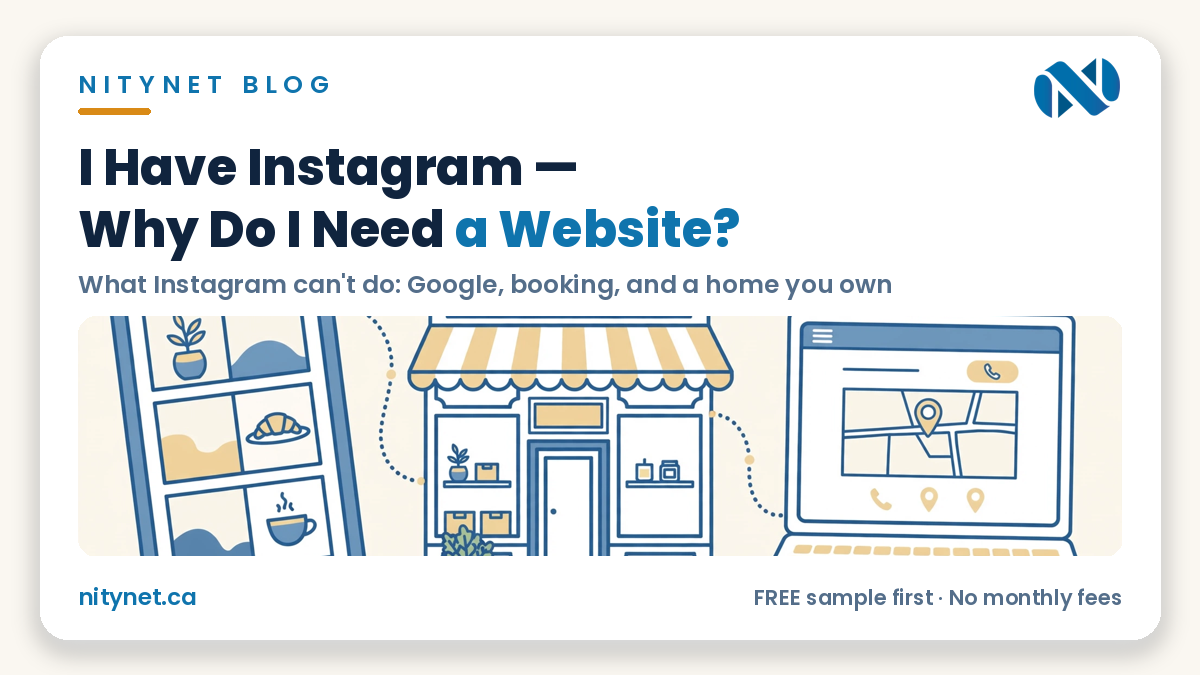
If you are asking do I need a website if I have Instagram, here is the honest short answer: yes — if you want customers who do not already follow you to find you, trust you, and contact you easily. Instagram is a great place to show your work. It is not a great place to run your business. Your website is the one place online that you own, that Google can find, and that answers every question a new customer has — your services, your prices, your hours, and how to book or call you — without an app, an account, or an algorithm in between. This guide explains what Instagram does well, what it cannot do, and how the two work best together.
What Instagram does well — keep doing it
Let us be clear first: Instagram is genuinely useful for a small business, and nothing in this article is a reason to delete your account.
- It shows your work beautifully. Before-and-after photos, finished projects, new arrivals, daily specials — visual businesses like salons, restaurants, florists, clinics and trades were made for it.
- It builds trust and personality. People like buying from businesses that feel real and active. Your stories and reels do that well.
- It keeps regulars close. Followers see your updates, your offers and your seasonal hours.
The problem is not Instagram itself. The problem is relying on it as your only home online. That is where it starts costing you customers — quietly, every week.
What Instagram cannot do for your business
1. People searching on Google cannot find your posts
When someone in Toronto searches “florist near me”, “barber open Sunday” or “physio clinic in North York”, Google shows websites and Google Business listings — not Instagram posts. A customer who has never heard of you will almost never find you through Instagram search, because Instagram search mostly finds people who already know your name. A website is built to be found by strangers. That is the biggest difference between the two, and for most local businesses it is the whole argument.
2. You do not own your audience there
Your followers belong to the platform, not to you. If your account is hacked, limited, or accidentally flagged — something small businesses report regularly — years of photos and followers can disappear overnight, and there is no phone number to call to get them back. Reach also changes whenever the algorithm changes: a post that reached most of your followers last year may reach a small fraction of them today. Your website and your domain name are yours. Nobody can take them away or quietly turn down your visibility.
3. It cannot answer a customer’s real questions
A new customer usually wants five things fast: what do you offer, how much does it cost, where are you, when are you open, and how do I book or call? On Instagram, those answers are scattered across highlights, old posts and a link that keeps changing. Many visitors give up and tap the next business instead. A website puts all five answers on clear pages — services, prices, map, hours, and a tap-to-call or booking button — in about five seconds.
4. There is no real booking, ordering or payment flow
“DM to order” works until it doesn’t: messages get buried, details get lost, and there is no proper record. A website gives you a real order or booking form, and — if you sell products — a proper online store with secure payments. You can see what that looks like in practice in the Flamingo Floral sample site: collections, same-day delivery details, store hours and tap-to-call ordering, all in one place — the kind of information a flower shop’s Instagram grid can only hint at.
The “rented land” problem, in one minute
Think of Instagram as a stall in someone else’s market. The market brings the crowd, which is great — but the owner sets the rules, changes them without asking, and can close your stall. Your website is your own shop on your own street: smaller crowd at first, but every visitor is there for you, and everything you build — your Google ranking, your reviews page, your booking system — stays yours and gets more valuable over time. Smart businesses use both: Instagram to be discovered and stay top-of-mind, and a website to turn that attention into calls, bookings and sales.
What a simple website actually adds
- Google visibility. A website plus a Google Business Profile is how “near me” searches find you.
- A complete, always-current answer. Services, prices, hours, service area and FAQs — updated once, correct everywhere.
- One-tap contact. Tap-to-call, WhatsApp, directions and a contact or booking form on every page.
- Trust signals in one place. Your Google reviews, photos of your work, and your story — presented professionally, not buried in a feed.
- A link that works everywhere. One address for your Google listing, your receipts, your vehicle, your window and — yes — your Instagram bio.
Getting found on Google is its own job, too — our SEO services in Toronto page explains, in plain English, how a small business shows up in Google search and on Google Maps, month by month.
And the flow runs both ways: your website links visitors to your Instagram for fresh photos, and your Instagram bio sends followers to your website to book, order and call. Each one makes the other stronger. If you are also weighing up total costs, our guide to how much a website costs in Toronto lays out the real market ranges.
How much does the website part cost?
Less than most owners expect — especially compared with what a lost customer is worth. NityNet’s packages are one-time prices with no monthly fees, and every package includes free hosting for 1 year and a free .com domain:
- Starter — $600: up to 5 pages, contact form, tap-to-call and WhatsApp buttons, Google Maps, free digital visit card.
- Business — $900: up to 10 pages, booking or order form, gallery, Google Business setup, blog and social links — the right fit for most Instagram-active businesses.
- Online Store — $1,500: up to 30 products with secure payments.
Already have a website that just looks dated? Our separate $300 flat redesign offer (not part of the packages, and not discounted) modernizes it and includes a free digital visit card. You can compare everything in the pricing section on our homepage.
Frequently asked questions
Can Instagram alone be enough for a very small business?
It can be a starting point for a hobby or a side project with more time than customers. But as soon as you depend on new customers finding you — especially through Google — Instagram alone leaves the biggest door closed. A simple website is what turns followers and searchers alike into bookings.
Will a website replace my Instagram?
No — and it should not. Keep posting; Instagram is your showcase and your community. The website is your foundation: the place your bio link points to, where Google sends new customers, and where booking and contact actually happen.
What if my customers really do all come from Instagram?
Then a website protects exactly that success: your bio link leads to a page you control, with your full services, prices and booking — so a follower who is ready to buy does not have to dig through DMs to do it. And if your account is ever lost or limited, your business still exists online, findable on Google, the next morning.
See your business as a website — free, before you pay anything
Do not guess what your business could look like beyond the grid — see it. NityNet will build you a free, personalized sample of your business as a real website, before you pay anything.
Start with the order form on our homepage: https://nitynet.ca/ — or email us at info@nitynet.ca. Packages start from $600, every package with free hosting for 1 year and a free .com domain, and no monthly fees. Toronto & GTA based, working with small businesses across Canada.